World War I (1917–1918)
When World War I began in 1914, the United States declared neutrality and avoided direct involvement for nearly three years. Increasing tensions—particularly German submarine warfare, American economic ties to the Allies, and the Zimmermann Telegram—eventually drew the country into the conflict.
In April 1917, the United States declared war on Germany and joined the Allied Powers. Although American forces entered the war late and lacked battlefield experience, their arrival provided a decisive increase in manpower and resources. U.S. troops participated in the final Allied offensives of 1918, contributing to Germany’s defeat.
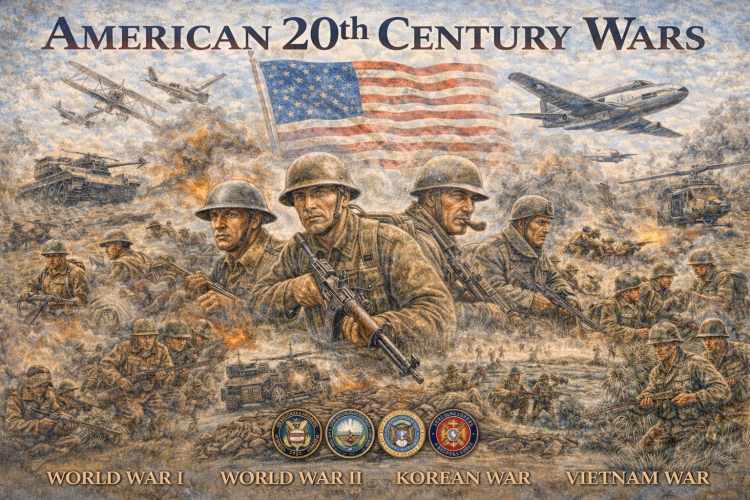
World War II (1941–1945)
The United States initially pursued neutrality during the early years of World War II, while providing material support to Allied nations. This policy ended after the Japanese attack on Pearl Harbor on December 7, 1941.
Once fully engaged, the United States mobilized on an unprecedented scale. Its industrial capacity, global logistics network, and expanding armed forces became central to Allied success. American forces fought major campaigns in Europe, North Africa, and the Pacific, playing a decisive role in the defeat of Nazi Germany and Imperial Japan.
By the war’s end in 1945, the United States emerged as one of the world’s two dominant superpowers, alongside the Soviet Union.
The Korean War was one of the first major military conflicts of the Cold War. After World War II, Korea was divided into North Korea and South Korea, reflecting broader tensions between communist and anti-communist blocs.
In 1950, North Korean forces invaded South Korea. The United States responded as part of a United Nations–led coalition, supplying the majority of troops, equipment, and command leadership. The conflict intensified after Chinese forces entered the war in support of North Korea.
Fighting ended in 1953 with an armistice rather than a peace treaty, leaving the Korean Peninsula divided near the original boundary.
Vietnam War (1955–1975)
The Vietnam War grew out of Cold War rivalries and the division of Vietnam into North Vietnam and South Vietnam. The United States gradually increased its involvement, particularly during the 1960s, deploying large numbers of troops and conducting extensive air campaigns.
Despite significant military investment, the United States was unable to achieve its strategic objectives. Domestic opposition and mounting costs led to American withdrawal in the early 1970s. In 1975, North Vietnam defeated South Vietnam and reunified the country under communist rule.
Persian Gulf War (1990–1991)
The Persian Gulf War began after Iraq invaded Kuwait in August 1990. The United States organized and led a broad international coalition, acting with United Nations authorization.
U.S. forces spearheaded Operation Desert Storm, relying heavily on air power and advanced military technology. Coalition ground forces quickly expelled Iraqi troops from Kuwait, ending major combat operations in early 1991.
Historical Significance
These wars illustrate how the United States evolved into a global military power during the 20th century. Together, they shaped:
- U.S. foreign policy and alliance systems
- Military doctrine and technology
- Domestic political debate over war and intervention
- America’s long-term role in global security
As additional child articles are completed, this hub will continue to serve as a structured entry point for understanding American warfare in the modern era.