The 20th century was defined not only by wars and social movements, but by the laws and treaties that reshaped American government, rights, and global influence. From Progressive reforms and New Deal legislation to civil rights laws and international agreements, these acts and treaties permanently transformed the United States.
This hub highlights the most important federal laws and international agreements that defined American life, governance, and diplomacy during the 1900s.
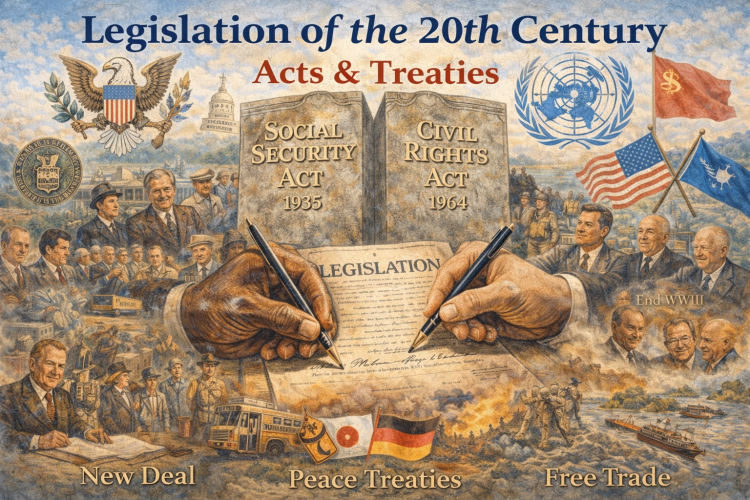
Note: This legislation hub is currently anchored by one detailed article. Additional 20th-century acts and treaties are being added progressively to build a comprehensive reference over time.
Progressive Era Legislation (1901–1917)
Early 20th-century reformers sought to curb corporate power, improve public welfare, and strengthen democracy through federal legislation.
Key Acts
- Pure Food and Drug Act (1906) – Regulated food and medicine safety
- Meat Inspection Act (1906) – Established federal oversight of meatpacking
- Clayton Antitrust Act (1914) – Strengthened antitrust enforcement
- Federal Reserve Act (1913) – Created the U.S. central banking system
- 16th Amendment (1913) – Authorized the federal income tax
- 17th Amendment (1913) – Mandated direct election of U.S. senators
These reforms expanded federal authority and laid the foundation for modern regulatory government.
World War I & Interwar Legislation (1917–1929)
America’s entry into World War I and the turbulent postwar years produced major political and constitutional changes.
Key Acts & Amendments
- Espionage Act (1917) – Restricted interference with war efforts
- Sedition Act (1918) – Criminalized criticism of the government during wartime
- 18th Amendment (1919) – Established Prohibition
- Volstead Act (1919) – Enforced Prohibition
- 19th Amendment (1920) – Granted women the right to vote
These measures reshaped civil liberties, social norms, and democratic participation.
The New Deal Era (1933–1939)
In response to the Great Depression, the federal government enacted sweeping economic and social reforms.
Key Acts
- Emergency Banking Act (1933) – Stabilized the banking system
- Social Security Act (1935) – Created retirement and unemployment insurance
- National Labor Relations Act / Wagner Act (1935) – Protected labor unions
- Securities Act (1933) & Securities Exchange Act (1934) – Regulated financial markets
- Fair Labor Standards Act (1938) – Established minimum wage and overtime rules
These laws permanently expanded the role of government in economic life.
World War II & Postwar Global Treaties (1941–1950)
World War II and its aftermath transformed the United States into a global leader through military alliances and international institutions.
Key Treaties & Agreements
- United Nations Charter (1945) – Established the United Nations
- Bretton Woods Agreements (1944) – Created the IMF and World Bank
- Marshall Plan (1948) – Rebuilt Western Europe after WWII
- North Atlantic Treaty (1949) – Created NATO
These agreements marked America’s shift toward permanent global engagement.
Cold War & National Security Legislation (1947–1991)
The Cold War era produced laws aimed at containing communism and strengthening national defense.
Key Acts
- National Security Act (1947) – Created the Department of Defense, CIA, and NSC
- McCarran Internal Security Act (1950) – Targeted suspected communists
- Nuclear Non-Proliferation Treaty (1968) – Limited spread of nuclear weapons
- Strategic Arms Limitation Treaties (SALT I & II) – Restricted nuclear arsenals
These laws shaped U.S. military policy and civil liberties for decades.
Civil Rights & Social Reform Legislation (1954–1970s)
Grassroots activism forced the federal government to confront racial inequality and discrimination.
Key Acts
- Civil Rights Act (1964) – Banned segregation and discrimination
- Voting Rights Act (1965) – Protected minority voting rights
- Fair Housing Act (1968) – Prohibited housing discrimination
- 24th Amendment (1964) – Abolished poll taxes
These laws represent some of the most significant expansions of civil rights in U.S. history.
Late 20th-Century Legislation (1970s–1990s)
As the century closed, legislation increasingly focused on regulation, accountability, and global responsibility.
Key Acts & Treaties
- Clean Air Act (1970) – Established environmental protections
- War Powers Resolution (1973) – Limited presidential war authority
- Americans with Disabilities Act (1990) – Prohibited disability discrimination
- NAFTA (1994) – Created a North American free-trade zone
- Patriot Act (2001) (borderline 21st century but consequential)
These measures addressed modern challenges in governance, trade, and rights.
Why 20th-Century Legislation Matters
The acts and treaties of the 20th century:
- Expanded federal power
- Redefined civil rights
- Established America’s global leadership
- Created the framework for modern economic and social policy
Together, they explain how the United States evolved from an industrial nation into a global political, military, and economic power.
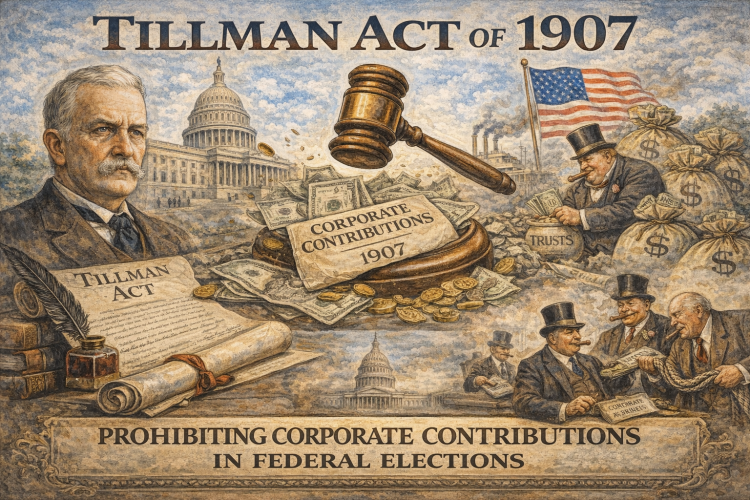
One of the earliest efforts to regulate money in American politics was the Tillman Act of 1907. Passed during the Progressive Era, the act prohibited corporations and national banks from making direct financial contributions to federal political campaigns. Although enforcement was initially weak, the Tillman Act marked the first federal campaign finance law and laid the groundwork for later election reforms. Read more about the Tillman Act of 1907.
Articles in Progress
This legislation hub is being expanded with detailed articles on major 20th-century laws and treaties, including:
- Pure Food and Drug Act (1906)
- Federal Reserve Act (1913)
- Social Security Act (1935)
- Civil Rights Act (1964)
- Voting Rights Act (1965)
- National Security Act (1947)
- Marshall Plan (1948)