Early Life and Military Career
Ulysses S. Grant was born on April 27, 1822, in Point Pleasant, Ohio. He attended the United States Military Academy at West Point, graduating in 1843. Grant served with distinction during the Mexican–American War, gaining valuable battlefield experience that later shaped his leadership style.
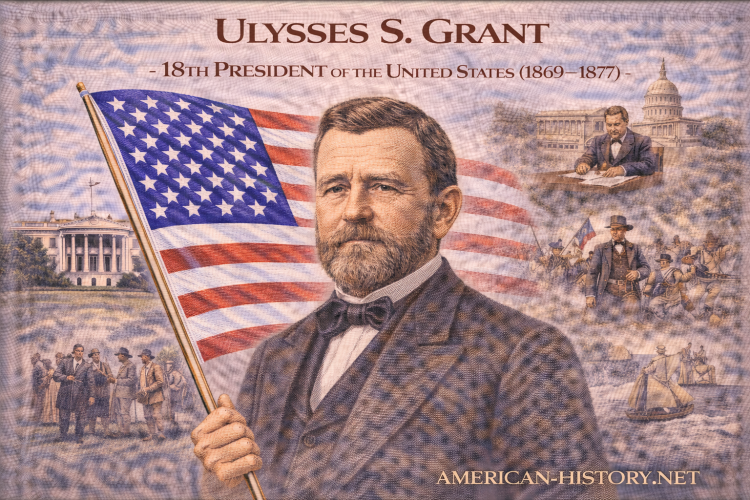
Leadership in the American Civil War
Grant rose rapidly through the ranks of the Union Army due to his determination, strategic insight, and willingness to take decisive action. He secured major victories at Fort Donelson, Vicksburg, and Chattanooga, earning a reputation as one of the Union’s most effective generals.
In 1864, President Abraham Lincoln appointed Grant General-in-Chief of the Union Army. He coordinated Union forces across multiple fronts and ultimately forced Confederate General Robert E. Lee to surrender at Appomattox Court House in 1865, effectively ending the Civil War.
Grant emerged from the war as a national hero.
Presidency of Ulysses S. Grant
Riding his immense popularity, Grant was elected the 18th President of the United States in 1868 and served two terms from 1869 to 1877.
His presidency focused heavily on Reconstruction, aiming to protect the civil rights of formerly enslaved African Americans in the Southern states. Grant supported the 15th Amendment, which guaranteed voting rights regardless of race, and used federal troops to combat violent organizations such as the Ku Klux Klan.
Achievements and Challenges
Grant’s administration achieved several important successes:
- Strengthened enforcement of civil rights laws
- Stabilized the post-war economy initially
- Improved relations with Great Britain through peaceful arbitration
However, his presidency was also marred by numerous corruption scandals, many involving members of his administration rather than Grant himself. These scandals damaged public confidence and overshadowed many of his accomplishments.
The Panic of 1873, a severe economic depression, further weakened Grant’s second term.
Later Life and Legacy
After leaving office, Grant embarked on a highly successful world tour, meeting foreign leaders and receiving widespread acclaim. In his final years, while battling terminal cancer, he wrote his Personal Memoirs, widely regarded as one of the finest military autobiographies in American history.
Ulysses S. Grant died on July 23, 1885.
Historical Significance
Today, Grant is remembered as:
- One of the most important Union generals in U.S. history
- A president committed to civil rights during Reconstruction
- A complex figure whose leadership achievements outweighed the failures of his administration
Modern historians increasingly rank Grant more favorably, recognizing his crucial role in preserving the Union and advancing civil rights during one of America’s most difficult eras.