Background: Texas Under Mexican Rule
Until the early 19th century, Texas was part of the Spanish Empire. After Mexico gained independence from Spain in 1821, Texas became a northern frontier province of the new Mexican nation. At the time, the region was sparsely populated and vulnerable to raids by Native American tribes.
To strengthen control over Texas, the Mexican government encouraged settlers from the United States to move into the region. Over time, the population of American settlers grew rapidly and soon outnumbered the Mexican population living in Texas.
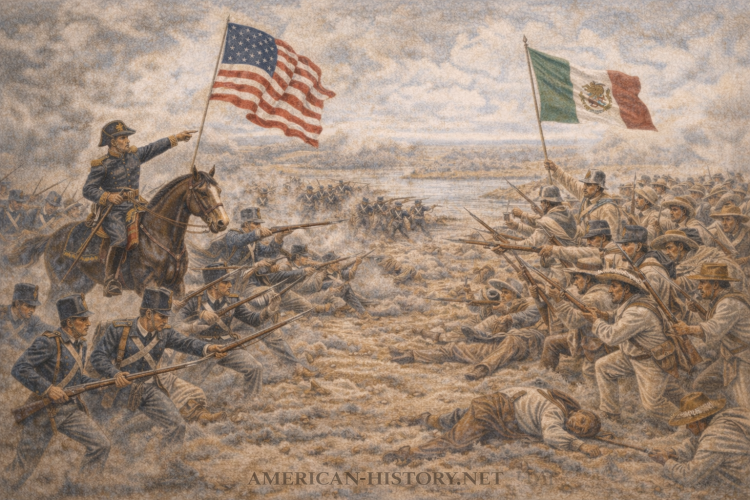
Rising Tensions and the Texas Revolution
By the 1830s, the Mexican government became increasingly concerned about the growing American presence in Texas and attempted to exert greater political and military control over the territory. Many settlers resisted these measures, leading to rising tensions between Texas and the Mexican authorities.
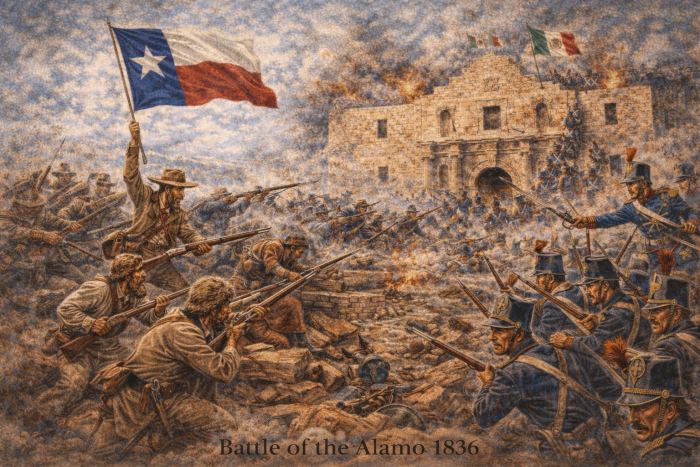
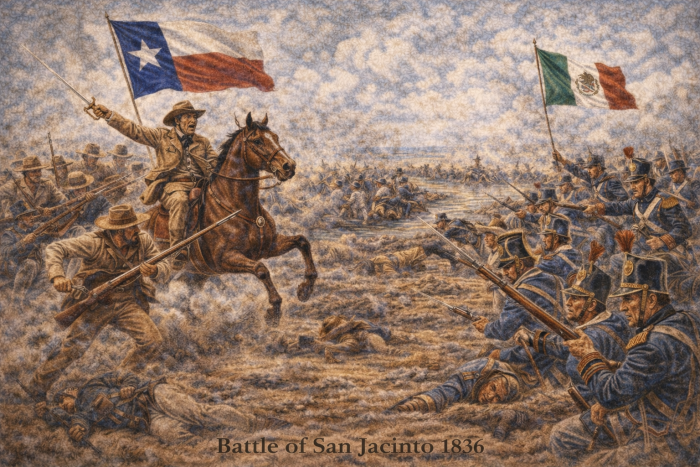
In 1835, armed conflict erupted between Texan settlers and Mexican forces. This struggle became known as the Texas Revolution. Early battles included events such as the Battle of the Alamo, where Texan defenders were defeated, and the Battle of San Jacinto in 1836, where Texan forces secured a decisive victory.
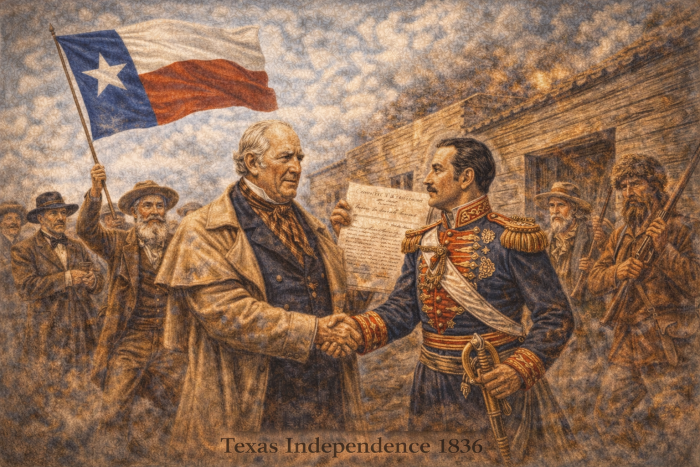
Following this victory, Texas declared its independence from Mexico and established itself as the Republic of Texas.
Texas as an Independent Republic
After gaining independence in 1836, Texas existed as an independent nation for nearly a decade. During this period, many Texans favored joining the United States, but annexation was delayed due to political concerns within the U.S. government.
One major issue was slavery. Texas permitted slavery, and admitting it as a state threatened to upset the balance between free states and slave states in the United States. As a result, annexation was postponed despite popular support within Texas.
Texas Joins the United States
In 1845, the United States Congress approved the annexation of Texas. Texas officially became the 28th state of the United States, ending its status as an independent republic.
Mexico, however, never recognized Texas independence and viewed the annexation as an act of aggression. The situation was further complicated by a dispute over Texas’s southern boundary. Mexico claimed the border lay at the Nueces River, while the United States asserted that it extended to the Rio Grande.
Border Dispute and the Outbreak of War
In 1846, the U.S. government sent troops into the disputed territory between the Nueces River and the Rio Grande to enforce its border claim. Mexico responded by sending its own forces into the area.
Clashes between Mexican and American troops in this disputed region led directly to the outbreak of the Mexican–American War in April 1846. What began as a border dispute soon escalated into a full-scale conflict between the two nations.
Consequences and Historical Significance
The annexation of Texas and the resulting war dramatically reshaped North America. The conflict ended with the Treaty of Guadalupe Hidalgo in 1848, under which Mexico ceded vast territories to the United States in exchange for financial compensation.
These events intensified national debates over territorial expansion and slavery, contributing to political tensions that would later culminate in the American Civil War.