Native American Origins
Archaeological and genetic evidence suggests that the ancestors of Native Americans arrived in the Americas sometime between approximately 13,000 and 40,000 years ago.
As glaciers retreated and sea levels rose, this land bridge disappeared. By that time, human populations had already spread throughout North and South America, adapting to a wide range of climates and environments. The final major migrations are generally believed to have occurred around 13,000 years ago, although research in this area continues to evolve.
Native American Location
The term Native American is most commonly used to describe the indigenous peoples of North America, including tribes such as the Cherokee, Iroquois, Mohawk, Sioux, Apache, Cheyenne, Navajo, and Lakota.
In a broader historical and anthropological sense, the indigenous peoples of Central and South America are also part of the same ancestral migration story. In Central America, civilizations such as the Maya and Aztec developed complex societies, cities, and systems of writing long before European contact.
In South America, the Inca built one of the largest empires in the pre-Columbian world, centered in the Andes Mountains of modern-day Peru. Together, these civilizations demonstrate the remarkable diversity and sophistication of indigenous societies across the Americas.
Native American History Timeline
After arriving in the Americas, Native American peoples gradually spread across the continents, developing distinct cultures, languages, and social systems based on their environments. For thousands of years, these societies flourished independently.
This changed dramatically after 1492, when Christopher Columbus reached the Caribbean. European exploration soon turned into colonization, conquest, and settlement. In Central and South America, Spanish forces destroyed the Aztec and Inca empires within a few decades.
In North America, Native American tribes faced centuries of conflict, disease, displacement, and warfare. During the colonial era, tribes fought against Spanish, French, and British forces, often being drawn into European rivalries. After the American Revolution (1775–1783), Native Americans increasingly faced conflict with the expanding United States, leading to a long series of wars, forced removals, and broken treaties.
Native American Cultures
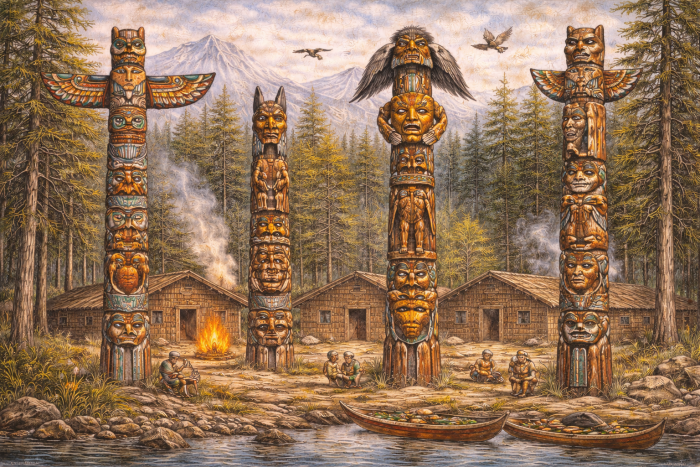
By the time Europeans arrived, hundreds of Native American tribes lived across North America. Historians and anthropologists commonly group these tribes into cultural regions based on geography, including the Arctic, Subarctic, Northwest Coast, California, Plateau, Great Basin, Plains, Northeast, Southeast, and Southwest.
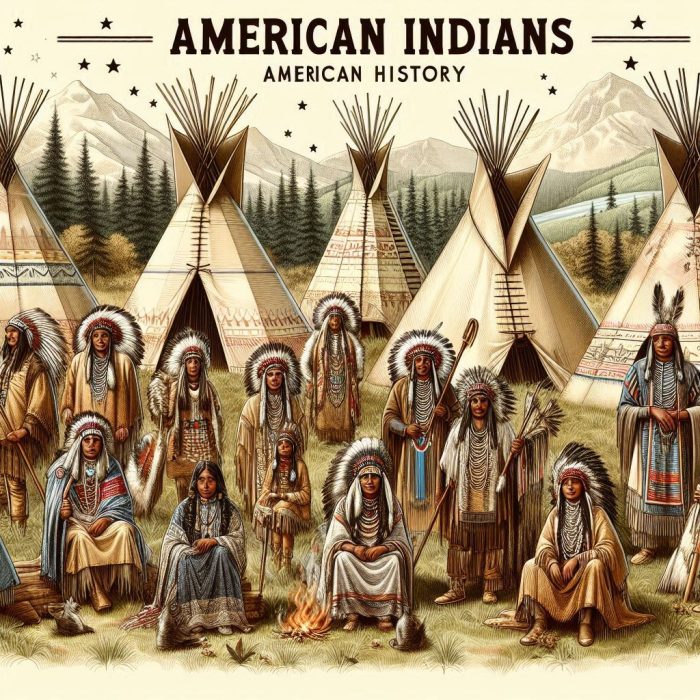
Each region shaped the culture of the tribes who lived there. For example, Plains tribes relied heavily on bison hunting, which led to a nomadic lifestyle, the use of teepees, and limited agriculture. In contrast, Southwest tribes such as the Pueblo built permanent settlements and practiced farming, while Northwest Coast tribes developed rich fishing-based economies.
Across all regions, Native American cultures demonstrated deep knowledge of the natural world, strong social traditions, and complex belief systems. These cultures evolved over thousands of years and remain an essential part of American history today.
Related Articles