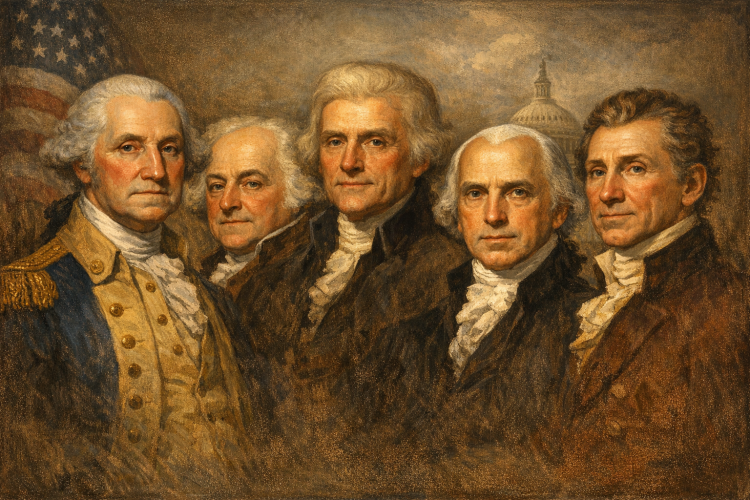
The Founding Fathers of the United States were the political leaders, thinkers, and revolutionaries who guided the nation through independence and the creation of its earliest institutions. While many shaped the republic through diplomacy, law, and military service, a small group went on to serve as President of the United States, defining the role itself during the nation’s formative years.
Their presidencies bridged the Revolutionary era and the early federal government, transforming revolutionary ideals into lasting systems of governance.
Founding Fathers Who Became President
George Washington (1789–1797)
Founding Father Role: Commander-in-Chief of the Continental Army; President of the Constitutional Convention
George Washington led American forces to victory in the American Revolutionary War and became the nation’s first President. He established the traditions of executive leadership, civilian control of the military, and peaceful transfer of power.
John Adams (1797–1801)
Founding Father Role: Diplomat; Continental Congress delegate; Independence advocate
John Adams played a critical diplomatic role during the Revolution and later became President during a period of international tension. He avoided full-scale war with France and was the first President to live in the White House.
Thomas Jefferson (1801–1809)
Founding Father Role: Principal author of the Declaration of Independence
Jefferson expanded the nation through the Louisiana Purchase, doubling U.S. territory. His presidency emphasized limited government, individual liberty, and religious freedom.
James Madison (1809–1817)
Founding Father Role: Architect of the U.S. Constitution and Bill of Rights
Known as the “Father of the Constitution,” Madison led the nation during the War of 1812. His presidency tested the durability of the young constitutional system under foreign pressure.
James Monroe (1817–1825)
Founding Father Role: Revolutionary War officer; diplomat; statesman
Monroe’s presidency ushered in the Era of Good Feelings. He articulated the Monroe Doctrine, asserting American opposition to European colonial expansion in the Western Hemisphere.