Donald Trump
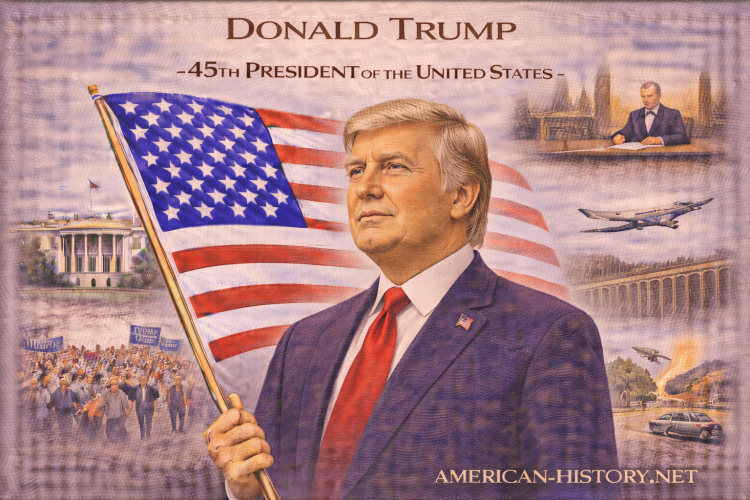
Donald Trump is an American businessman and political figure who served as the 45th and 47th President of the United States, holding two non-consecutive terms in office. His presidencies marked a significant departure from traditional political norms and reshaped the modern Republican Party.
Life Before the Presidency
Donald John Trump was born on June 14, 1946, in New York City. He was raised in a wealthy family and later joined his father’s real estate business, which he expanded and rebranded as the Trump Organization. Trump became widely known for high-profile real estate projects, particularly in New York City, as well as hotels, casinos, and golf courses.
Outside business, Trump gained national recognition as a media personality. He authored several books and hosted the reality television series The Apprentice, which significantly increased his public profile and helped establish him as a household name.
2016 Presidential Campaign
In 2015, Trump announced his candidacy for the Republican presidential nomination. Running as a political outsider, he defeated a large field of Republican rivals and secured the party’s nomination.
His campaign emphasized themes such as immigration restriction, trade protectionism, and opposition to political elites. Trump’s rhetoric and communication style differed sharply from previous presidential candidates and drew intense media attention and public debate.
Election as 45th President
In the 2016 general election, Trump faced Democratic nominee Hillary Clinton. Although Clinton won the national popular vote, Trump secured victory in the Electoral College, winning key swing states.
He was inaugurated as the 45th President of the United States on January 20, 2017.
First Presidential Term (2017–2021)
Trump’s first term was marked by major policy shifts and frequent controversy.
Domestic Policy
- Enacted significant tax cuts through the Tax Cuts and Jobs Act of 2017
- Appointed three Supreme Court justices
- Rolled back numerous federal regulations
Immigration
Trump made immigration enforcement a central focus of his presidency. His administration implemented stricter border policies, pursued construction of a border wall, and issued executive orders restricting travel from several countries. These measures were widely debated and frequently challenged in court.
Foreign Policy and “America First”
Trump pursued an “America First” approach to foreign policy. His administration:
- Withdrew from or renegotiated several international agreements
- Pressured NATO allies to increase defense spending
- Engaged in direct diplomacy with North Korea
- Adopted a confrontational trade stance toward China
Impeachments
Donald Trump was impeached twice by the House of Representatives during his first term:
- In 2019, related to dealings with Ukraine
- In 2021, following the January 6 attack on the U.S. Capitol
He was acquitted by the Senate in both trials.
2020 Election and Intervening Period
Trump ran for re-election in 2020 but was defeated by Democratic candidate Joe Biden, who became the 46th President of the United States. Trump disputed the election results, leading to prolonged political and legal controversy.
After leaving office in January 2021, Trump remained a dominant figure in Republican politics and announced another presidential campaign.
Second Presidential Term (From 2025)
Following the 2024 election, Trump returned to office and was inaugurated as the 47th President of the United States on January 20, 2025. His non-consecutive presidencies place him in a rare category of U.S. presidents, similar to Grover Cleveland, who served as both the 22nd and 24th president.
Historical Significance
Donald Trump’s presidencies had a lasting impact on American politics, political discourse, and party alignment. His leadership style, use of media, and policy priorities continue to influence debates about governance, democracy, and the future direction of the United States.
Further Reading
- Donald Trump – Biography (Wikipedia)
- Great Again: How to Fix Our Crippled America (2016)