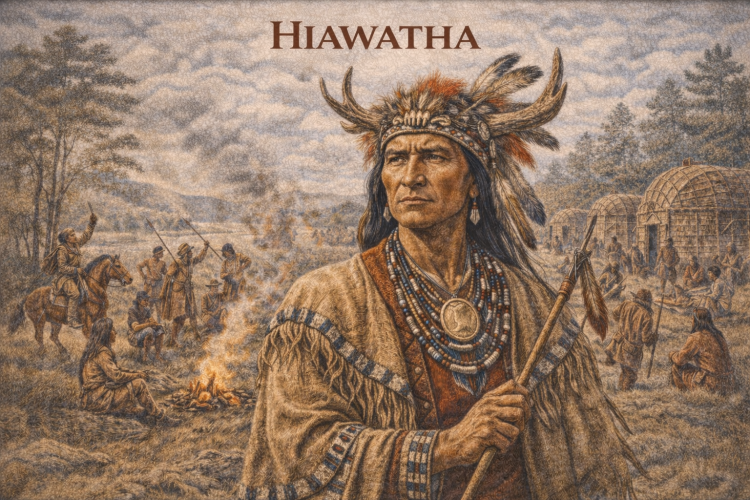
Hiawatha is a foundational figure in Native American history, best known for his central role in the creation of the Iroquois Confederacy (also known as the Haudenosaunee). Remembered as a diplomat, lawgiver, and peacemaker, Hiawatha worked alongside the prophet Deganawida (the Great Peacemaker) to unite rival nations under a shared system of governance known as the Great Law of Peace.
Although elements of Hiawatha’s life are preserved through oral tradition, his influence on Indigenous political organization in northeastern North America is widely recognized.
Early Life and Background
According to Iroquois oral history, Hiawatha was born sometime in the 15th or early 16th century, likely among the Onondaga or Mohawk people. During this period, the Iroquois nations were divided by frequent warfare, cycles of revenge, and political instability.
Hiawatha is said to have personally suffered great loss during these conflicts. His grief and experiences are central to his transformation into a peacemaker and helped shape his lifelong commitment to ending intertribal violence.
Hiawatha and the Iroquois Confederacy
Hiawatha became a key ally of Deganawida, a visionary leader who preached unity and peace among the warring nations. Together, they traveled across Iroquois territory, spreading a message that emphasized:
- Unity over division
- Law over revenge
- Collective decision-making
- Peace among nations
Their efforts culminated in the unification of five nations:
- Mohawk
- Oneida
- Onondaga
- Cayuga
- Seneca
These nations formed what became known as the Iroquois Confederacy or Five Nations, later expanded to the Six Nations with the addition of the Tuscarora in the early 18th century.
The Great Law of Peace
The Confederacy was governed by a constitution known as the Great Law of Peace, one of the most sophisticated political systems in pre-colonial North America. It established:
- A Grand Council with representatives from each nation
- Rules for leadership, succession, and removal of chiefs
- Protections for individual rights and religious freedom
- Procedures for diplomacy, war, and peace
The Great Law emphasized consensus rather than majority rule, ensuring that all nations had a voice in major decisions.
Core Principles of the Confederacy
Key objectives of the Great Law of Peace included:
- Ending intertribal warfare
- Maintaining internal peace and unity
- Defending shared territories
- Regulating relations with outside nations
- Establishing a representative, council-based government
This system allowed the Iroquois Confederacy to become one of the most powerful political and military alliances in eastern North America.
Decline and Disruption
The Confederacy remained influential for centuries but faced increasing pressure during the colonial era. Conflicts involving French, British, and later American forces weakened unity among the nations.
During the American Revolutionary War, divisions emerged within the Confederacy as some nations supported the British while others allied with the Americans. In 1779, U.S. forces led by General John Sullivan launched a devastating campaign against Iroquois villages, severely undermining their power.
After the war, treaties forced many Iroquois people to relocate. Some nations remained in New York, while others moved to Canada, where descendants still live today.
Legacy and Influence
Hiawatha’s legacy endures as a symbol of peace, unity, and Indigenous governance. The principles of the Great Law of Peace are often cited as an influence on early American thinkers, including Benjamin Franklin, and are sometimes linked to ideas later reflected in the Articles of Confederation and the U.S. Constitution.
Today, Hiawatha is remembered not as a conqueror, but as a builder of nations, whose vision of cooperation and balance continues to resonate in Native American political traditions.