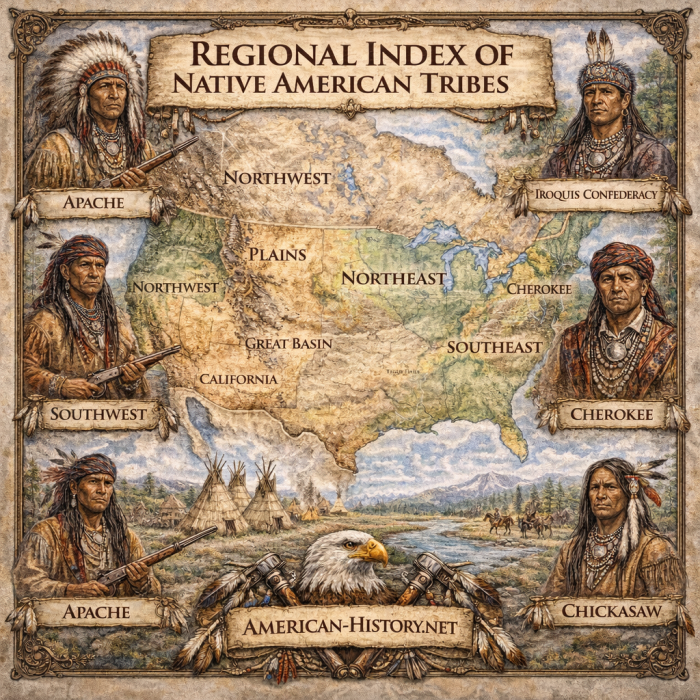
The Iroquois Confederacy, also known as the Haudenosaunee, was one of the most influential political alliances in Native American history. Formed between the late 15th and early 17th centuries, the Confederacy united several powerful tribes of the northeastern woodlands and played a major role in shaping early North American history.
Well before European colonization reached its height, the Iroquois had developed a sophisticated system of governance, diplomacy, and collective decision-making. Their political structure influenced relations between Native American nations and later affected interactions with French, British, and American colonists.
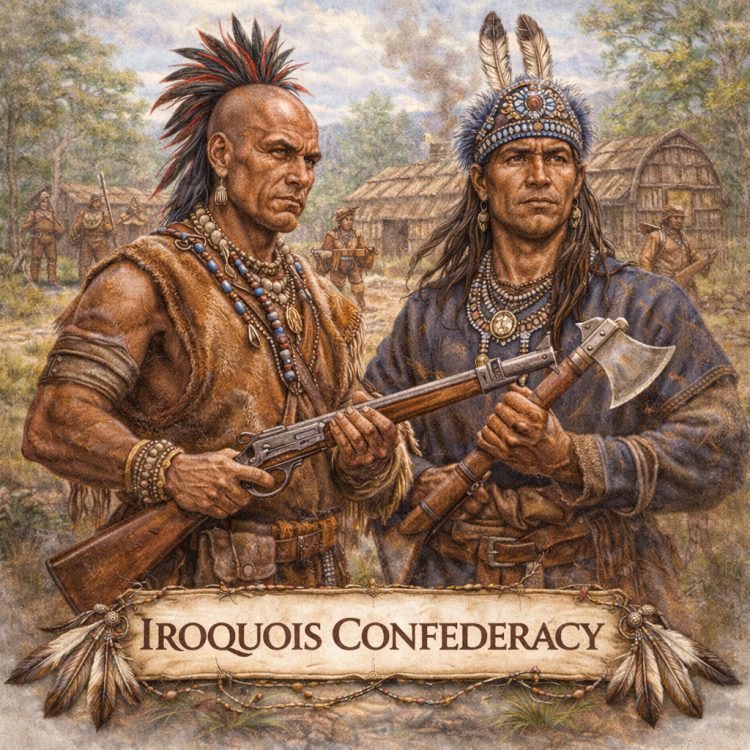
The Six Nations of the Iroquois Confederacy
The Confederacy was originally made up of five nations, known as the Five Nations:
- Mohawk
- Oneida
- Onondaga
- Cayuga
- Seneca
In 1722, the Tuscarora joined the alliance, forming what became known as the Six Nations.
Each nation maintained its own leadership and territory, but all participated in shared decision-making through the Confederacy council. This unity allowed the Iroquois to defend their lands, control trade routes, and exert influence across much of the northeastern region of North America.
Formation of the Confederacy
According to Iroquois tradition, the Confederacy was founded by Dekanawida (the Great Peacemaker) and his spokesman Hiawatha. Their goal was to end destructive inter-tribal warfare and replace it with peace, unity, and shared governance.
Their teachings led to the creation of the Great Law of Peace, which served as the Confederacy’s constitution. This law established rules for leadership, conflict resolution, and cooperation among the nations, creating one of the earliest and most enduring systems of representative government in North America.
The Great Law of Peace
The Great Law of Peace formed the foundation of Iroquois political life. It guaranteed:
- Individual freedoms
- Religious tolerance
- Shared use of land and resources
- Collective decision-making through councils
- A structured justice system
Membership in the Confederacy was not limited by ethnicity, and new groups could be adopted. The law emphasized balance, harmony, and responsibility, ensuring peace both within the Confederacy and with neighboring nations.
Because of its complexity and longevity, the Great Law of Peace is often cited as one of the earliest democratic systems in North America.
Conflict with European Powers
During the 17th century, the Iroquois became deeply involved in the struggle between France and Britain for control of North America. The Confederacy formed trading relationships with the English and Dutch, which brought them into direct conflict with France and its Native American allies, including the Huron and Algonquin peoples.
This period saw a series of brutal conflicts often linked to the fur trade, sometimes called the Beaver Wars. Although the French launched several large military campaigns against the Iroquois, neither side achieved lasting dominance, and shifting alliances continued for decades.
The American Revolution and the Fall of the Confederacy
The American Revolutionary War (1775–1783) caused a deep division within the Iroquois Confederacy.
- The Oneida and Tuscarora largely supported the American colonists
- The Mohawk, Seneca, Cayuga, and Onondaga sided with the British
In 1779, the United States launched the Sullivan Expedition, a major military campaign aimed at destroying Iroquois villages, crops, and food supplies in New York. The campaign devastated the Confederacy’s homeland and effectively broke its military power.
After the war, Iroquois lands were seized or divided. Many Mohawk and Cayuga people relocated to Canada, while other nations were confined to smaller territories in New York, Wisconsin, and Ontario.
Legacy of the Iroquois Confederacy
Although its political power declined after the American Revolution, the Iroquois Confederacy did not disappear. The Haudenosaunee continue to exist today as distinct nations with cultural, political, and legal identities.
The Confederacy’s emphasis on unity, representative leadership, and peaceful governance remains one of the most significant contributions of Native American societies to world history—and firmly secures the Iroquois place among the most influential Native American tribes in U.S. history.