
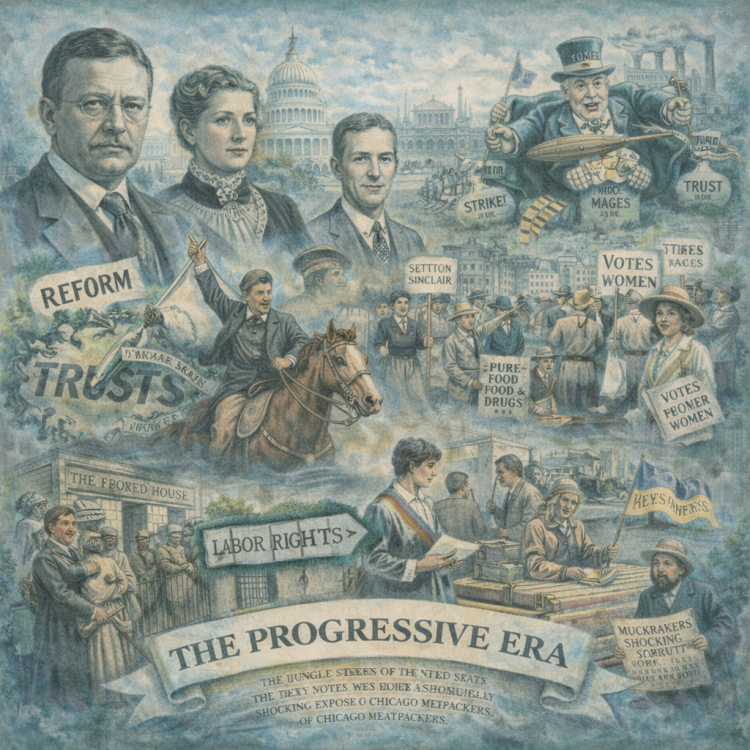
The Progressive Era was a period of widespread social activism, political reform, and government intervention in the United States, generally spanning from the 1890s through the early 1920s. It emerged as a response to the profound challenges created by rapid industrialization, urban growth, mass immigration, economic inequality, and political corruption during the late 19th century.
Progressives believed that many of the nation’s problems could be solved through education, regulation, democratic reform, and a more active government. Although the movement began at the local level, it quickly expanded to state and national politics, reshaping American society and redefining the role of government in everyday life.
🔧 Click to Reveal: The Progressive Era (1890s–1920s)
Goals of the Progressive Movement
Progressives sought to fix problems caused by industrialization, urbanization, immigration, and political corruption through reform and government action.
Homestead Act (1862)
Granted 160 acres of land to settlers, encouraging westward expansion and shaping American agriculture and settlement patterns.
Transcontinental Railroad (1869)
Connected the nation coast to coast, accelerating industrial growth, migration, and economic integration.
Pendleton Civil Service Act (1883)
Ended the spoils system by requiring merit-based hiring for federal government jobs.
Rise of Labor & Socialist Movements
Groups such as the Socialist Party of America gained support among workers, immigrants, and reformers seeking economic justice.
Muckrakers & The Jungle
Journalists like Upton Sinclair exposed corporate abuses and unsafe conditions, prompting public outrage and reform.
Meat Inspection Act (1906)
Established federal oversight of food safety, reflecting Progressive demands for consumer protection.
Progressive Presidents
Leaders like Theodore Roosevelt and Woodrow Wilson expanded federal power to regulate business and promote reform.
19th Amendment (1920)
Granted women the right to vote, marking one of the most significant democratic expansions of the Progressive Era.
Foundations of Change Before the Progressive Era
Some developments that predate the Progressive Era helped create the conditions that made reform necessary.
The Homestead Act (1862)
Passed during the Civil War, the Homestead Act of 1862 allowed adult citizens and intended citizens to claim 160 acres of public land, provided they lived on and improved it. Signed into law by President Abraham Lincoln, the act distributed over 160 million acres to approximately 1.6 million settlers.
While the act encouraged westward expansion and economic opportunity, it also accelerated:
- Displacement of Native Americans
- Agricultural commercialization
- Regional inequality
These consequences later fueled Progressive calls for fairness, regulation, and reform.
The First Transcontinental Railroad (1869)
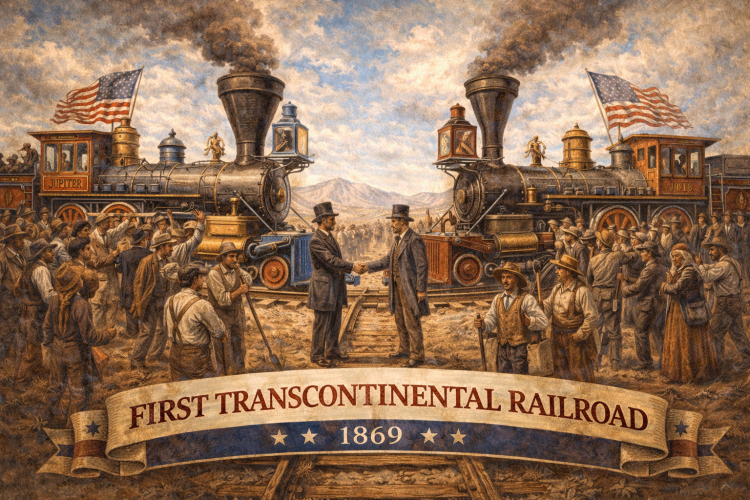
Completed in 1869, the First Transcontinental Railroad connected the eastern rail network at Council Bluffs, Iowa, to the Pacific Coast near San Francisco Bay. Built by private companies with substantial government subsidies, it transformed the national economy.
The railroad:
- Spurred industrial growth
- Encouraged mass migration
- Linked national markets
At the same time, it highlighted problems such as corporate power, labor exploitation, and corruption, which became central concerns of Progressives.
Political Reform and Government Accountability
Key Progressive-era reforms aimed to reduce corruption, professionalize government, and expand political participation.
The Pendleton Civil Service Act (1883)
The Pendleton Act marked a major step toward political reform by requiring that federal government jobs be awarded based on merit rather than political patronage. Applicants were required to pass competitive examinations, reducing corruption and inefficiency.
This law reflected Progressive beliefs that professionalism and expertise should replace the spoils system in government.
Labor, Immigration, and Political Movements (continued)
Founded in 1901, the Socialist Party of America emerged as a significant political force during the Progressive Era, drawing support from industrial workers, coal miners, former Populist farmers, and immigrant communities, particularly Jewish, Finnish, and German Americans.
The party advocated for workers’ rights, public ownership of key industries, and greater economic equality, positioning itself as a response to the hardships created by rapid industrialization. Although the Socialist Party succeeded in electing officials at local and state levels, its strong opposition to U.S. involvement in World War I led to internal divisions, government repression, and a gradual decline in influence by the early 1920s—despite its lasting impact on American labor reform and political debate.
The Black Hand and Organized Crime (1903)
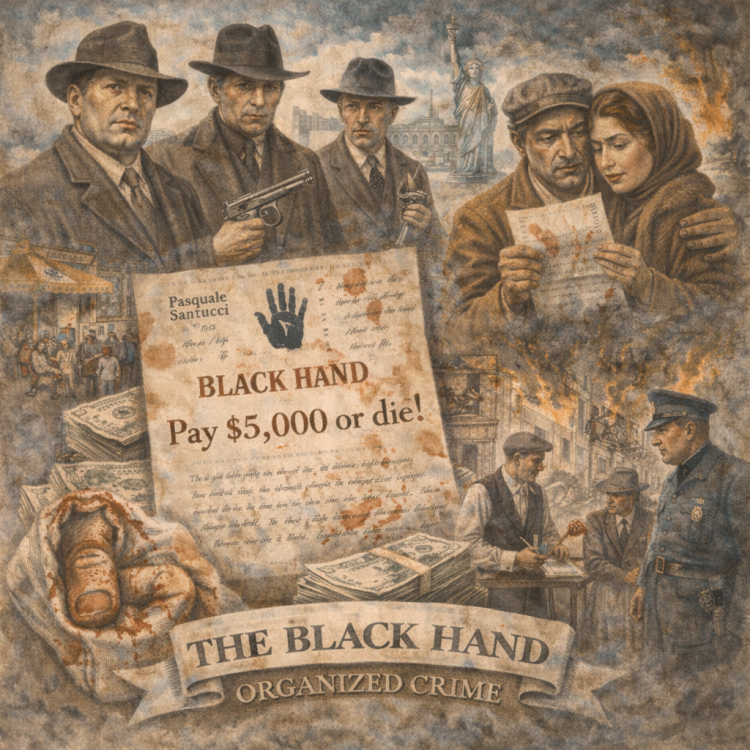
In the early 20th century, waves of Italian immigration coincided with the emergence of criminal organizations such as the Black Hand. Beginning around 1903, these loosely organized groups used extortion and intimidation, often targeting fellow immigrants.
While not representative of immigrant communities as a whole, the Black Hand contributed to public fears surrounding immigration and urban crime. These anxieties fueled Progressive-era efforts to reform policing, urban governance, and social services.
Muckrakers and the Power of Journalism
The Jungle by Upton Sinclair (1906)
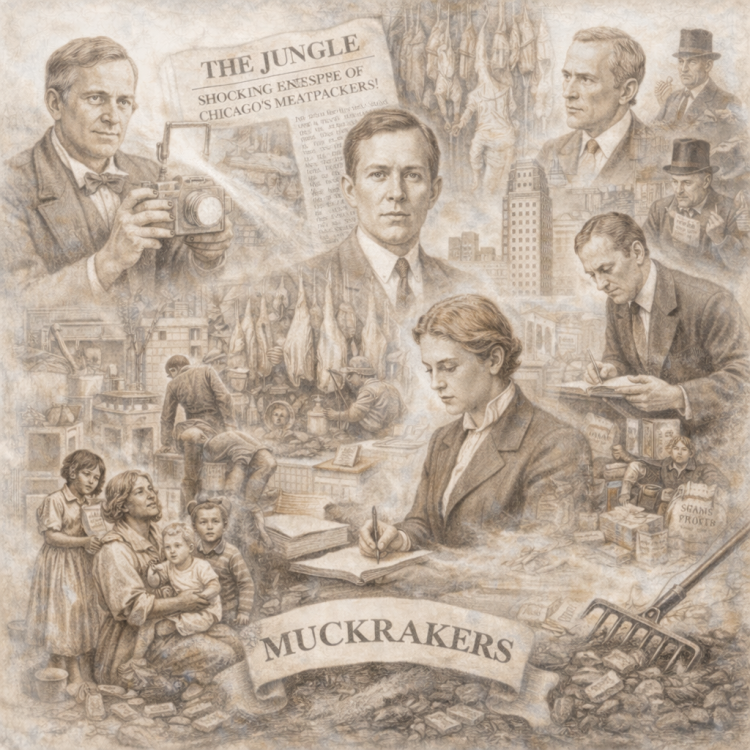
One of the most influential works of the Progressive Era was Upton Sinclair’s novel The Jungle, published in 1906. Sinclair intended to expose the brutal conditions faced by immigrant laborers in Chicago’s meatpacking industry.
Although readers focused primarily on unsanitary food practices, the book sparked national outrage and demonstrated the power of investigative journalism, often called muckraking, to influence public opinion and government action.
The Meat Inspection Act (1906)
In direct response to public concern generated by The Jungle, Congress passed the Meat Inspection Act of 1906, which was signed into law by President Theodore Roosevelt. The act required:
- Federal inspection of meatpacking facilities
- Sanitary standards for slaughterhouses
- Accurate labeling of meat products
This legislation marked a major expansion of federal consumer protection and set a precedent for future regulatory laws.
Progressive Leadership in the White House
Theodore Roosevelt and the Square Deal (1901–1909)
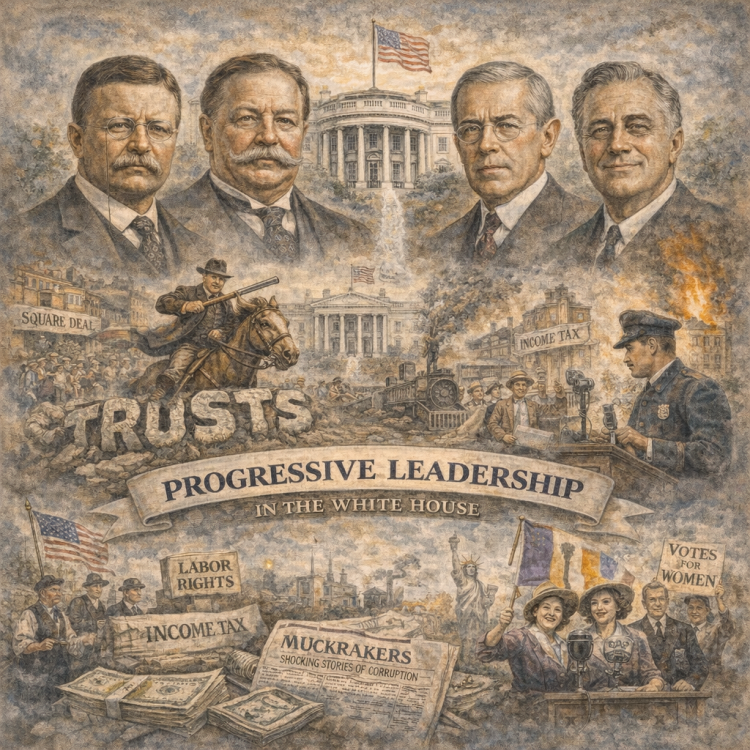
Theodore Roosevelt, the 26th President of the United States, was a central figure of the Progressive Era. As a Republican reformer, he promoted his Square Deal, which emphasized:
- Fairness for workers
- Regulation of corporations
- Conservation of natural resources
Roosevelt expanded the power of the presidency and used federal authority to regulate monopolies, earning a reputation as a trust-buster. His leadership helped legitimize the idea that government could act as a force for social good.
Woodrow Wilson and Progressive Reform (1913–1921)
Elected in 1912, Woodrow Wilson continued Progressive reforms under Democratic leadership. His administration:
- Reduced tariffs
- Established a federal income tax following the 16th Amendment
- Strengthened banking oversight
Although Wilson initially pledged neutrality in World War I, his presidency reflected the Progressive belief in expert governance and economic regulation. His wartime policies, however, also revealed tensions between reform and civil liberties.
Expanding Democracy and Women’s Rights
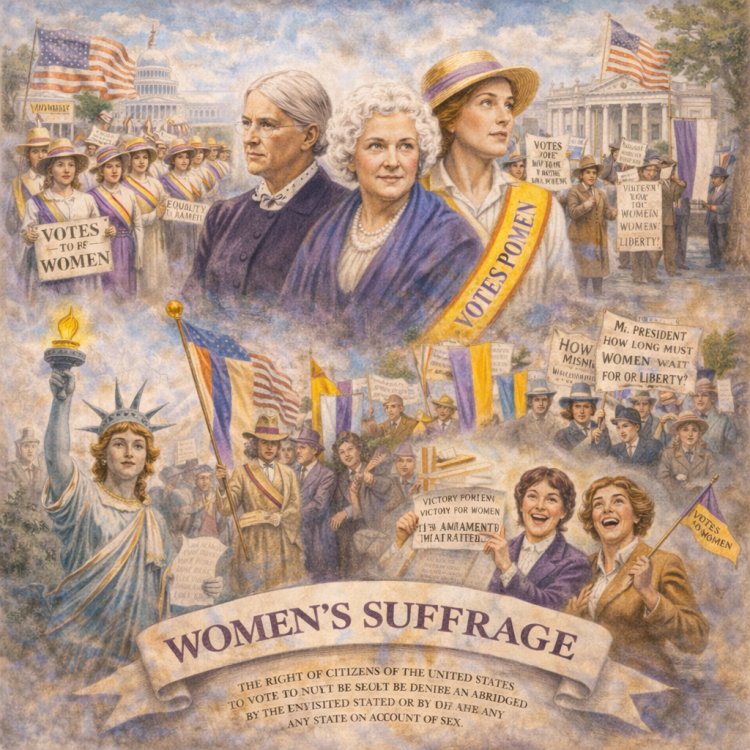
The 19th Amendment (1920)
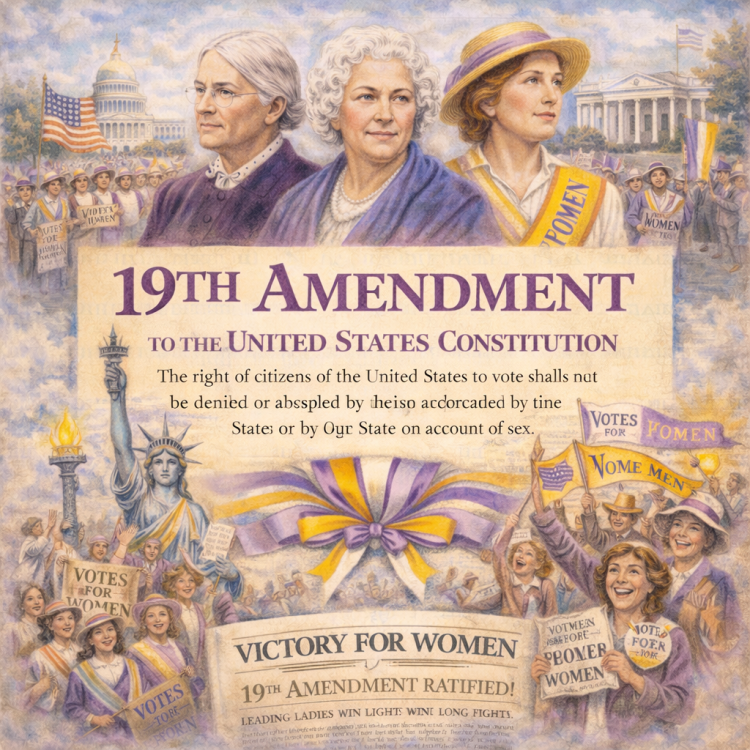
One of the most enduring achievements of the Progressive Era was the passage of the 19th Amendment, which granted women the right to vote. The women’s suffrage movement, active since the mid-19th century, gained momentum through:
- Grassroots activism
- International cooperation
- Progressive arguments for political equality
Ratified on August 26, 1920, the amendment enfranchised approximately 26 million women, dramatically expanding American democracy.
Conclusion: The Legacy of the Progressive Era
The Progressive Era transformed the United States by reshaping the relationship between citizens, corporations, and government. Reformers sought to make society more just, efficient, and democratic in response to the disruptions of industrial capitalism.
Although Progressives did not solve every problem—and sometimes excluded marginalized groups—their efforts resulted in:
- Greater government accountability
- Expanded democratic participation
- Stronger consumer and labor protections
The reforms of this era laid the groundwork for later changes during the New Deal and continue to influence American political debates today.
❓ The Progressive Era — Frequently Asked Questions
What was the Progressive Era?
The Progressive Era was a period of social, political, and economic reform in the United States from the 1890s to the 1920s aimed at addressing problems caused by industrialization and urbanization.
What problems did Progressives want to fix?
Progressives targeted political corruption, unsafe working conditions, corporate monopolies, poverty, and lack of democratic participation.
Why is the Progressive Era important?
The era expanded the role of government, strengthened democracy, and laid the groundwork for later reforms such as the New Deal.
How did journalism influence reform?
Investigative journalists known as muckrakers exposed corruption and unsafe practices, mobilizing public support for reform legislation.
What major democratic change came from this era?
The 19th Amendment granted women the right to vote, significantly expanding political participation.
🧠 The Progressive Era — Knowledge Quiz
Test your understanding of Progressive reforms, key legislation, and historical impact. Click Submit to reveal answers — green = correct, red = incorrect.
📚 Glossary: The Progressive Era
Progressive Era
A period of reform from the 1890s to the 1920s aimed at correcting problems caused by industrialization.
Muckrakers
Journalists who exposed corruption and unsafe practices to promote reform.
Pendleton Act
A law establishing merit-based hiring for federal government jobs.
The Jungle
A novel by Upton Sinclair that exposed conditions in the meatpacking industry.
Square Deal
Theodore Roosevelt’s program promoting fairness for workers, consumers, and businesses.
19th Amendment
The constitutional amendment granting women the right to vote in 1920.
Introduction
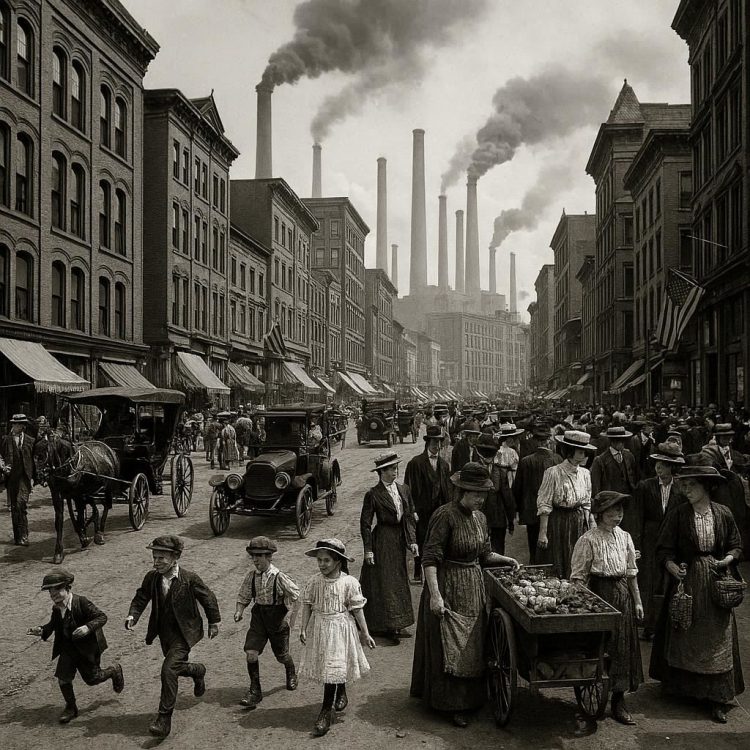
The main objectives of the Progressive Era included eliminating any problems that had been caused due to widespread industrialization, urbanization, immigration and systemic political corruption.
It was thus named because people actively worked to change the social and political landscape of the country. Initially, the movement operated locally but it soon expanded to state and national levels as well. Following are some key events of the Progressive Era.
🔧 Click to Reveal: The Progressive Era (1890s–1920s)
Goals of the Progressive Movement
Progressives sought to fix problems caused by industrialization, urbanization, immigration, and political corruption through reform and government action.
Homestead Act (1862)
Granted 160 acres of land to settlers, encouraging westward expansion and shaping American agriculture and settlement patterns.
Transcontinental Railroad (1869)
Connected the nation coast to coast, accelerating industrial growth, migration, and economic integration.
Pendleton Civil Service Act (1883)
Ended the spoils system by requiring merit-based hiring for federal government jobs.
Rise of Labor & Socialist Movements
Groups such as the Socialist Party of America gained support among workers, immigrants, and reformers seeking economic justice.
Muckrakers & The Jungle
Journalists like Upton Sinclair exposed corporate abuses and unsafe conditions, prompting public outrage and reform.
Meat Inspection Act (1906)
Established federal oversight of food safety, reflecting Progressive demands for consumer protection.
Progressive Presidents
Leaders like Theodore Roosevelt and Woodrow Wilson expanded federal power to regulate business and promote reform.
19th Amendment (1920)
Granted women the right to vote, marking one of the most significant democratic expansions of the Progressive Era.
The Homestead Act (May 20, 1862)
These were several laws, enacted during the Civil War, that enabled any adult citizen (or intended citizen) to claim 160 acres of government-surveyed land. The only condition was that the person should not have ever taken up arms against the government.
These laws were clearly defined in the Homestead Act of 1862. More than 160 million acres of land was given away by the government to 1.6 million people throughout the United States as a result of the Act. The Act was passed and signed into law by President Abraham Lincoln.
First Transcontinental Railroad (May 8, 1869)
The first railroad that was ever constructed across an entire continent was made in the period between 1863 and 1869. Known originally as the ‘Pacific Railroad’, it was nearly 1912 miles long. It connected the eastern U.S. rail network at Council Buffs (Iowa) with the Pacific coast at the Oakland Long Wharf (San Francisco Bay).
The First Transcontinental Railroad was built by three private companies over land provided by the Homestead Act. The construction of the railroad was financed by both the government and state subsidy bonds, alongside company-issued mortgage bonds. It was officially opened for business on May 10th, 1869.
Pendleton Act (January 16, 1883)
This was a federal law passed by the Congress and signed into law by then-President Arthur, on January 16th, 1883. The act mandated that federal government positions should be awarded based on merit and not on political patronage. This act ensured that governmental positions were attained by potential government employees having to clear specific competitive examinations, rather than courting political patronage.
Establishment of the Socialist Party of America (January 11, 1901)
A socialist, democratic political party in the United States of America, it was established on January 11, 1901. It had numerous elected officials up until the First World War. It was particularly liked by Jewish, Finnish and German immigrants, coal miners and former populist farmers.
The party’s strong opposition to America’s involvement in the First World War led to prominent defections and vigilante persecution. It refused to form coalitions with other political parties and always remained strongly anti-Fascist. In its last decades, many of its prominent members fundamentally disagreed amongst each other regarding socialist beliefs. It officially changed its name to ‘Social Democrats, USA’ in 1973.
The Black Hand Mafia (January 10, 1903)
A concerted series of extortions of wealthy Italians began in 1903. it was practiced by smaller gangs and the Italian mafia. Its roots can be traced back to the Kingdom of Naples as far back as the 1700s. Italian immigrants in the United States formed criminal syndicates and largely victimized fellow immigrants for power. On occasion, the criminals used violence against law enforcement as well.
The Jungle (February 28, 1904-1906)
This was a novel published in 1906 by journalist Upton Sinclair. It portrayed the harsh conditions that immigrants in the United States were forced to live in. Unfortunately, most readers focused on unsanitary health practices in the meat industry rather than the actual purpose of the book.
During 1904, before writing the book, Sinclair spent a few weeks researching the meatpacking plants of the Chicago stockyards, where some of the information he used in his book came from. Regardless of the negative response, he was considered a journalist who effectively exposed corruption in government.
Meat Inspection Act (June 30, 1906):
In 1906, as a result of the response from Sinclair’s novel ‘The Jungle’ which shed some light on the processes used in the meatpacking industry, the Meat Inspection Act of 1906 was signed by President Theodor Roosevelt. The act prohibited the sale of adulterated or misbranded livestock.
It also enforced that livestock were slaughtered under sanitary conditions meeting proper health and safety requirements. The law also applied to imported products, which were treated with equal scrutiny.
Teddy Roosevelt as President (May 4, 1909)
Theodore Roosevelt served as the 26th president of the United States of America from 1901 to 1909. He was the driving force behind the Progressive Era, as leader of the Republican Party. He is one of the four presidents whose face is depicted on Mount Rushmore.
Woodrow Wilson (December 11, 1913)
When Woodrow Wilson, from the Democratic Party, was elected to the post of the 28th President of the United States, he implemented a series of Progressive policies in economics, ratified the 16th Amendment and imposed a small income tax on higher earnings. He also effectively mobilized public opinion behind tariff changes. President Wilson pledged to keep the United States out of the First World War, narrowly winning reelection in 1916.
The 19th Amendment (August 26, 1920)
The Woman’s Suffrage movement began in the late 19th century. It sought political equality, social reforms and the right to vote for women. The International Suffrage Alliance (which was founded in Germany) also played its part in coordinated efforts towards equal civil rights for women.
The 19th Amendment was officially adopted on August 26, 1920 as a direct result of the Women’s Suffrage Movement. It enfranchised nearly 26 million women to vote just before the 34th U.S. Presidential Election.
Summary
- Progressive Era was an era of social activism and reform. It generally dates from 1890s to the 1920s.
- Some of the most popular American presidents, such as Theodore Roosevelt, served during the Progressive Era.
- The 19th Amendment was passed during the Progressive Era. It enfranchised 26 million women to vote.
- Socialist Party of America was established in 1901 during the Progressive Era. It became a significant party across U.S. over subsequent years.
- Reforms were adopted which better regulated industrialization, urbanization, immigration and political spending.